Contents
mill docs
Hardening a spec first
The mill validates the spec at the start of every run. A spec with real defects fails that gate — and because the reviewer reads source truth, a large spec can surface a different defect on each pass: you fix one, rerun, and the next round finds the next. Fixing at the source and rerunning the whole pipeline each time is correct but slow, and it drags a human through one decision at a time.
spec-prep moves that hardening into its own cheap loop that runs to
convergence before the implementation mill starts. It has no worktree and
no baseline — it only reads the code and rewrites its own copy of the spec —
so looping is fast, and the mill it feeds sails straight through the spec
gate it would otherwise park at.
The loop
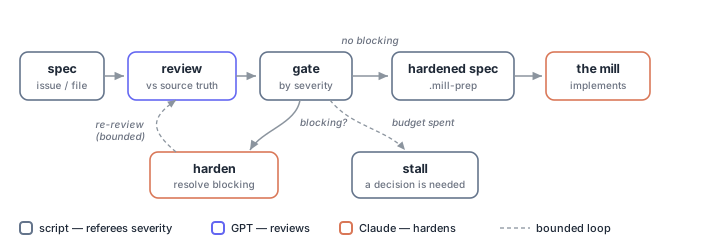
A rival model reviews the spec against the code, exactly as the mill’s own spec gate does. Then a hardener — a strong model with repository access — rewrites the spec to resolve each finding, grounded in the actual files and existing precedent, and the loop reviews again. It repeats until the review comes back clean or a round budget is spent.
Severity decides what blocks
The key move — and the reason the pre-flight converges where a bare rerun loop doesn’t — is that not every finding blocks:
- blocking / high findings must be resolved. A false claim about the code, a genuine contradiction, an ambiguity that changes the shape of the work — the spec can’t be implemented correctly until these are fixed.
- medium / low findings are recorded as accepted interpretations and carried into planning, not treated as blockers.
Demanding zero findings from an adversarial reader of a real codebase is an asymptote it never quite reaches — there is almost always one more serve-time edge case to name. And three more review gates sit downstream in the mill (plan review, per-chunk review, final compliance). So the pre-flight converges on “no blocking defects remain,” records the rest, and lets the pipeline’s later gates catch residual depth.
The hardener resolves; it doesn’t guess
For a finding that source truth settles — a wrong file reference, a schema
that should follow an existing type — the hardener corrects the spec and
cites the real code. For a genuine product decision that the code can’t
settle — expose a UI or stop at the API, add fixtures or test synthetically —
it picks the most conservative, smallest-scope reading, writes the spec to
that reading so it is unambiguous, and records the decision in
.mill-prep/spec_decisions.json for a human to review or override.
To decide those forks yourself up front, put authoritative answers in
.mill-prep/spec_answers.md before running; the hardener honors them exactly
rather than choosing. Either way, the finished spec carries a Spec-prep
record — every interpretation and decision made — so nothing is silently
chosen.
Running it
spec-prep 58                              # harden issue #58
spec-prep 58 --web                        # with the live dashboard
mill .mill-prep/spec.hardened.md --no-pr # then implement the hardened spec| Flag | Effect |
|---|---|
--web | Detach into the background with the live web dashboard. |
--fresh | Discard existing .mill-prep state and start over. |
--dest=PATH | Where to write the hardened spec (default .mill-prep/spec.hardened.md). |
The output is a spec file — with a title header, so a file-sourced mill run
derives a good PR title — that the mill consumes directly. If the source
issue was already sound, spec-prep finalizes on the first review with
nothing to change; if it can’t converge within the round budget, it stalls
with the unresolved findings, which usually means a product decision is
waiting for you in spec_answers.md.
State lives in its own .mill-prep/ directory (self-gitignored), so
spec-prep never collides with an implementation run’s .mill/ in the same
checkout. See running concurrently.